The Queen's Six and The Rose Consort of Viols - Troubled Times: Music and Espionage in Renaissance Englan (2026) Hi-Res
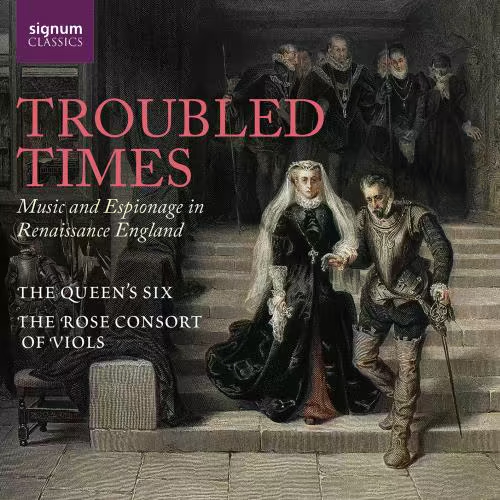
24bit-192.0 kHz FLAC (tracks +Booklet) | Classical | 01:04:17 | 2,06 GB
Troubled Times: Music and Espionage in Renaissance England explores sacred music written amid the religious and political instability of 16th-century England. Performed by The Queen’s Six with The Rose Consort of Viols, the programme examines how composers navigated shifting allegiances, censorship, exile, and suspicion, from the Henrician Reformation to the Elizabethan settlement. Works by Byrd, Taverner, Morley, Philips, Ferrabosco, and others reflect strategies of adaptation, concealment, and survival, whether through recusancy, foreign travel, or service at court. Placing music within its historical context, the recording highlights the complex relationship between faith, power, and artistic expression during a period of sustained upheaval.
At the turn of the 16th century, the liturgy of the English Church was a splendid spectacle. The soaring Gothic architecture of its churches and chapels was adorned with lavish rituals and the finest music. But by 1527, with Henry VIII seeking an annulment for his marriage to Catherine of Aragon from Pope Clement VII, political necessity set England upon a different religious course from its European neighbours. The subsequent division that emerged between reforming Protestants and traditional Catholics came to define the 16th century in England and music would come under heavy scrutiny from the authorities.
After decades of convulsions, existential theological debates seemed settled by Elizabeth I’s Parliament’s passing of the Act of Uniformity in 1558. However, could Catholics, with their adherence to the authority of the Bishop of Rome, truly be considered loyal English subjects? Suspicion of treachery would dog the Catholic community, driven by events such as the excommunication of Elizabeth by Pope Pius V in 1570 and wars against Europe’s Catholic powers (most famously the Spanish Armada in 1588).
In this turbulent religious landscape, composers faced great challenges in adapting their music to suit the requirements of the day’s authorities, often battling with their own religious convictions. Florid polyphony had been denounced by the Reformers and henceforth religious music must be in the vernacular English with textual intelligibility paramount. If a composer’s music seemed implicated in undermining the authority of the Anglican Church or if they themselves were associated with the Catholic community, the penalties might be severe.
Most famous among Catholic musicians in Protestant England was William Byrd. Appointed a Gentleman of the Chapel Royal in 1572, he led something of a double life, serving the Anglican monarch’s spiritual needs in the heart of power, yet also composing motets in Latin that seem thinly veiled ventriloquizations of the struggles of the English Catholic community. He and his family were cited for Recusancy, and he later retired to the Essex village of Stondon Massey where he wrote music for clandestine Catholic services. Only his standing in the eyes of Elizabeth (a music lover) seems to have saved him from severe punishments.
Similarly, Martin Peerson managed to maintain an eminent position in the Anglican establishment yet clearly harboured Catholic sympathies, rising to be Master of the Choristers at London’s St Paul’s Cathedral despite convictions of Recusancy and composing music in Latin. By contrast, John Wilbye was not a church musician but spent his life in the service of the wealthy Kytson family in Suffolk, an area of the country known to be rife with Recusant households. As such, he too aroused suspicion that he held Catholic sympathies. Likewise, Thomas Morley’s own beliefs are difficult to decipher at this distance, having secured the position as Organist of St Paul’s Cathedral, yet still composing Latin texted-music with potential double meanings. It has even been suggested that he was an informer on the Recusant Catholic community, such was the atmosphere of distrust. ...
Tracklist
1. The Queen's Six and The Rose Consort of Viols - Bull: Almighty God, which by the leading of a star
2. The Queen's Six and The Rose Consort of Viols - Taverner: Quemadmodum
3. The Queen's Six and The Rose Consort of Viols - Sampson: Quam pulcra es
4. The Queen's Six and The Rose Consort of Viols - Byrd: Cunctis diebus
5. The Queen's Six and The Rose Consort of Viols - Ferrabosco I: Vias tuas
6. The Queen's Six and The Rose Consort of Viols - Peerson: Who will rise up?
7. The Queen's Six and The Rose Consort of Viols - Wilbye: O God the rock of my whole strength
8. The Queen's Six and The Rose Consort of Viols - Morley: Out of the deep
9. The Queen's Six and The Rose Consort of Viols - Morley: Eheu sustulerunt
10. The Queen's Six and The Rose Consort of Viols - Morley: Domine Dominus noster
11. The Queen's Six and The Rose Consort of Viols - Bull: In nomine
12. The Queen's Six and The Rose Consort of Viols - Ferrabosco I: Laboravi in gemitu meo
13. The Queen's Six and The Rose Consort of Viols - Ferrabosco II: Fuerunt mihi lacrimae
14. The Queen's Six and The Rose Consort of Viols - Byrd: O salutaris hostia à 6
15. The Queen's Six and The Rose Consort of Viols - Philips: Beata Agnes
16. The Queen's Six and The Rose Consort of Viols - Dering: Factum est silentium
17. The Queen's Six and The Rose Consort of Viols - Byrd: Teach me, O Lord
Quick check before we show the links
Helps us keep automated scrapers from hammering the filehosts.