Management Accounting Information for Decision Making, 7th Edition
This post was published 4 years ago. Download links are most likely obsolete. If that's the case, try asking the uploader to re-upload.
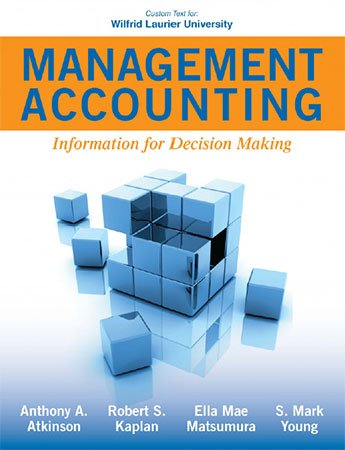
Anthony A. Atkinson (et al.) | 2019 | ISBN: 1618533517 | English | 248 pages | PDF | 233 MB
The seventh edition of Management Accounting, Information for Decision Making is the only textbook that treats management accounting with a coherent structure and a unified approach, rather than a series of disconnected chapters. This edition delivers an integrated flow of content that tracks the four foundational perspectives in the balanced scorecard (BSC), described by Strategic Finance as one of the major innovations in management accounting in the past 100 years.
• After an introductory chapter, the book addresses the BSC’s financial perspective, in Chapters 2-4, with an expanded and updated treatment of traditional costing material.
• Chapter 5 extends traditional costing with the modern time-driven activity-based costing (TDABC) approach for measuring product costs and profitability, with implications for decisions about pricing, product mix, and process efficiencies. The chapter includes a new section on applying TDABC to health care and a new case based on this content.
• Chapter 6 follows with a chapter, unique to this textbook, on customer costing, customer profitability, and customer performance measurement. This chapter provides the measurement foundations for the BSC’s customer perspective.
• The next two chapters provide in-depth treatment of the concepts and measurements for BSC's process perspective. Chapter 7 covers process costing and improvement. Chapter 8 introduces life-cycle, environmental, and innovation costing,
• Employee motivation in Chapter 9 provides the content for the BSC’s learning and growth perspective.
• Finally, Chapter 10, contains in-depth coverage of the BSC and strategy maps, bringing the content of all the previous chapters together. It demonstrates how to create and align the metrics in all four BSC perspectives to a company’s strategy, enabling the BSC to be used to describe, communicate, and implement an organization’s strategy.
• The book concludes with Chapter 11 on using budgets for planning and coordination, and Chapter 12 on financial control over responsibility centers.
Quick check before we show the links
Helps us keep automated scrapers from hammering the filehosts.